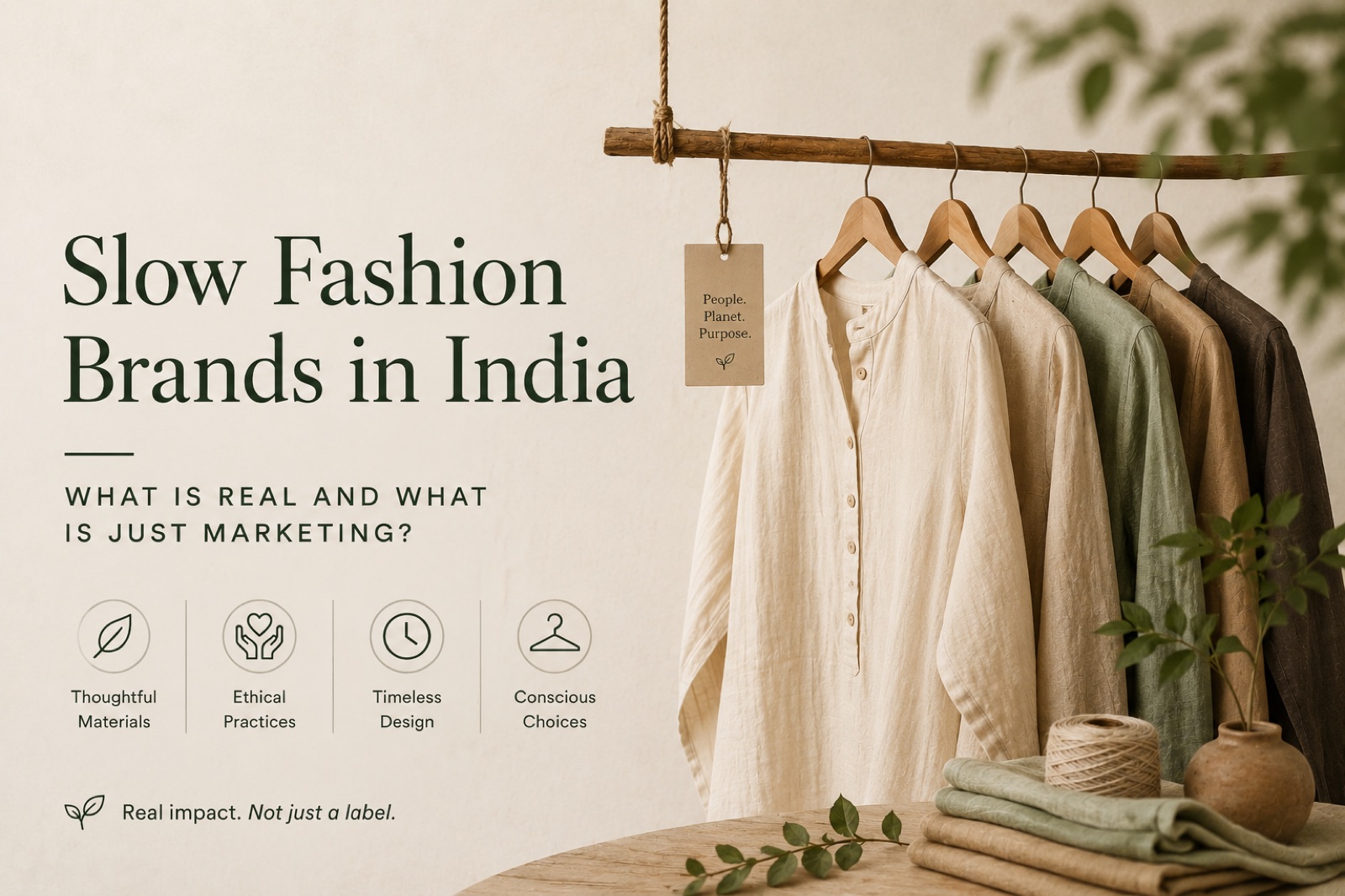
"Slow fashion" has become one of the most overused phrases in Indian fashion right now.
Every third brand on Instagram claims it. Marketplaces have entire "sustainable" sections. Even big fast fashion players have started using the language. And somewhere in all this noise, the actual meaning of slow fashion has gotten completely diluted.
This post is an attempt to cut through that. What does slow fashion actually mean in the Indian context? Which brands are genuinely doing it? And what should you look for before trusting a brand's claims?
What Slow Fashion Actually Means
Slow fashion is not a fabric choice. It's not a colour palette. It's not photography that looks earthy and handmade.
At its core, slow fashion means:
- Small-batch or made-to-order production — so nothing is made speculatively and discarded unsold
- Fair wages for the people making the clothes — artisans, tailors, embroiderers, dyers
- Natural or low-impact materials — pure cotton, linen, natural dyes, or at minimum AZO-free dyes
- Transparency about how and where things are made
- Pricing that reflects actual cost — not inflated MRP followed by a 60% "sale"
The word "sustainable" has been stretched so thin it barely means anything anymore. A brand selling polyester kurtas made in bulk with no information about their supply chain is not slow fashion, even if their aesthetic says otherwise.
The Greenwashing Problem in Indian Fashion
Here's something worth knowing: there is no regulatory standard in India for calling yourself a "slow fashion" or "sustainable" brand. Anyone can use the term.
What this means practically: a brand can claim handmade, artisan-made, or sustainable without being any of those things. Some common greenwashing patterns to watch out for:
- "Sustainable" with no specifics — what fabric? which dyes? made where?
- Constant deep discounts — if a brand runs 40–70% sales regularly, their MRP was never honest
- "Handmade" with no artisan story — who made it? where? how are they paid?
- Bulk production dressed up as small-batch — large catalogues with hundreds of SKUs updated weekly is not slow fashion.
The question to ask any brand: can you tell me who made this and what they were paid? A genuine slow fashion brand will answer that question. A greenwashing brand will give you a vague mission statement.
Slow Fashion Brands in India Worth Knowing
These are brands doing meaningful work in the Indian slow fashion space, each with a distinct approach.
Fabindia
The oldest and most well-known connector of Indian artisan craft to retail. They work with handloom weavers and craft clusters across the country. Not perfect, scale has forced some compromises but the underlying mission of artisan employment has been consistent for decades.
Chidiyaa
A Jaipur-based brand working with block printing and hand embroidery, known for detailed documentation of their craft process. Strong on storytelling and genuine about their production methods.
Pinklay
Another Jaipur label focused on handblock printing and heritage craft. Good fabric quality and consistent in their artisan-first approach.
Okhai
Run by the Tata Chemicals Society for Rural Development, Okhai employs rural women artisans across Gujarat. Strong community development focus. Every purchase directly supports a worker's livelihood.
No Nasties
100% GOTS-certified organic cotton, fair trade, and carbon neutral. One of the few Indian brands with credible third-party certifications across their supply chain. More basics-focused than craft-focused.
Serovey
A small-batch Jaipur label working directly with chhapai karigar families for hand block printing. Made-to-order, which means zero dead stock. Block printing rate is ₹80–100 per metre, paid to the artisan directly. Pure cotton, AZO-free dyes and No fake discounts, no urgency tactics.
Browse Serovey's handblock-printed collections
What to Actually Look For When Buying
If you're trying to build a genuinely slow wardrobe, here's a practical checklist:
On fabric:
- Is the fabric composition clearly listed? (100% cotton, not "cotton blend" or vague)
- Is the weight/GSM mentioned?
- Are the dye processes explained? (natural dyes, AZO-free, GOTS certified?)
On production:
- Is it made to order or small batch, or is there a large pre-stocked catalogue?
- Is there any information about where it's made — city, region, workshop type?
- Are the artisans named or featured anywhere?
On pricing:
- Does the price reflect the cost of handmade? (If a hand block printed dress is ₹499, something is off)
- Does the brand run frequent deep discounts? (Honest pricing doesn't need constant sales)
On transparency:
- Does the brand talk about their process, not just their aesthetic?
- Can you find out who made your garment?
None of this requires a brand to be perfect. It requires them to be honest.
A Note on Price and Value
One of the most common frustrations with slow fashion is the price. Handmade costs more than machine-made. That's not a flaw, it's the point.
When you buy a hand block printed cotton dress from a Jaipur karigar, the price includes:
- The cost of pure cotton fabric
- The time to carve or maintain the wooden block
- The artisan's skill and hours spent printing
- The correction process before a print is approved
- The tailoring and finishing
- A margin that allows the brand to keep doing this
Compare that to a machine-printed fast fashion piece. The low price is not a deal, it means someone in the supply chain was paid less than they should have been, or the material is inferior, or both.
Slow fashion asks you to buy less and buy better. The economics only work if the price is honest.
The Indian Craft Traditions Behind Slow Fashion
India already had slow fashion before it had the label. The country's textile heritage — block printing, natural dyeing, handloom weaving, embroidery — is one of the most sophisticated in the world.
These traditions are alive in places like:
- Jaipur — Bagru and Sanganeri block printing, dabu mud-resist printing, indigo dyeing
- Kutch — Ajrakh printing, Rogan art, mirror work embroidery
- Banaras — Brocade silk weaving
- Lucknow — Chikankari hand embroidery
- Pochampally — Ikat weaving
Every time you buy from a brand genuinely rooted in one of these traditions, you're not just buying a garment. You're buying into a craft that has survived for centuries and needs buyers to keep surviving.
Frequently Asked Questions
Is slow fashion in India affordable?
Genuine slow fashion costs more than fast fashion, that's unavoidable. But several Indian slow fashion brands offer well-made pieces in the ₹1500–4000 range, which is fair for handmade, artisan-produced clothing.
How do I know if a brand is genuinely slow fashion or just using the label?
Ask questions. Where is it made? Who made it? What fabric? What dyes? A genuine brand will answer. Look for artisan stories, process documentation, and honest pricing with no fake discounts.
What's the difference between slow fashion and sustainable fashion?
Sustainable fashion focuses primarily on environmental impact that is materials, waste, carbon. Slow fashion is broader, it includes fair wages, artisan employment, and small-batch production alongside environmental concerns. Many Indian slow fashion brands are both.
Are slow fashion brands in India available online?
Yes. Most of the brands listed above sell directly through their own websites, which also means more of the margin stays with the brand and the artisans.
Why is handmade clothing more expensive?
Because it takes time. A hand block printed metre of fabric can take hours of skilled labour. That time has a cost, and honest pricing reflects it.